Sketching from Another Perspective
Drawn from Communities explores how young Bhutanese are reimagining their own relationships to the everyday objects and actions of Bhutanese identity. Bhutan is proud of its living heritage, and so we hope to share a little glimpse of people who have taken up the behind-the-scenes work making the things that feel so quintessentially Bhutanese–across the diversity of the four approaches, and beyond its borders to Bhutanese studying and working abroad.
Often I have heard about the arts and crafts as they are enshrined and protected as formal arts: the zorig chusum . But I was especially curious about how young people take up these jobs, how they learn the skills and how they see tradition and change in their everyday work contributing to the sights, sounds, scents, tases and feel of Bhutanese icons. We started with a sense of respect, to the people, the relationships, and how they produce their own webs of meaning.
How could we share the passion and skill of young Bhutanese who found their path crafting the everyday objects we take for granted, without subjecting them to the gaze of social media? How do we represent their own creativity and authorship, and when was it right to link their study to carrying on tradition? Could we learn more about the little ways that people connect the past and the present.
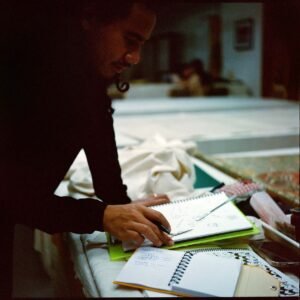
I decided to pair the words of our collaborators with drawings from a Bhutanese artist. Sketches to capture a perspective on the people: their personality, their own connection and skill in their work, the spaces they filled–but also to make room for more observations from our readers, to leave room for recognition and connection to the creativity of an artists’ take. I am excited to work with VAST artist Wang Rana Gurung for these sketches to capture the style and feeling of these conversations. Similarly, to bring her curiosity and generosity to conversations, we recruited journalist and creative professional Yangday La to interview and compose the stories we share.
Seeking an Auspicious Start
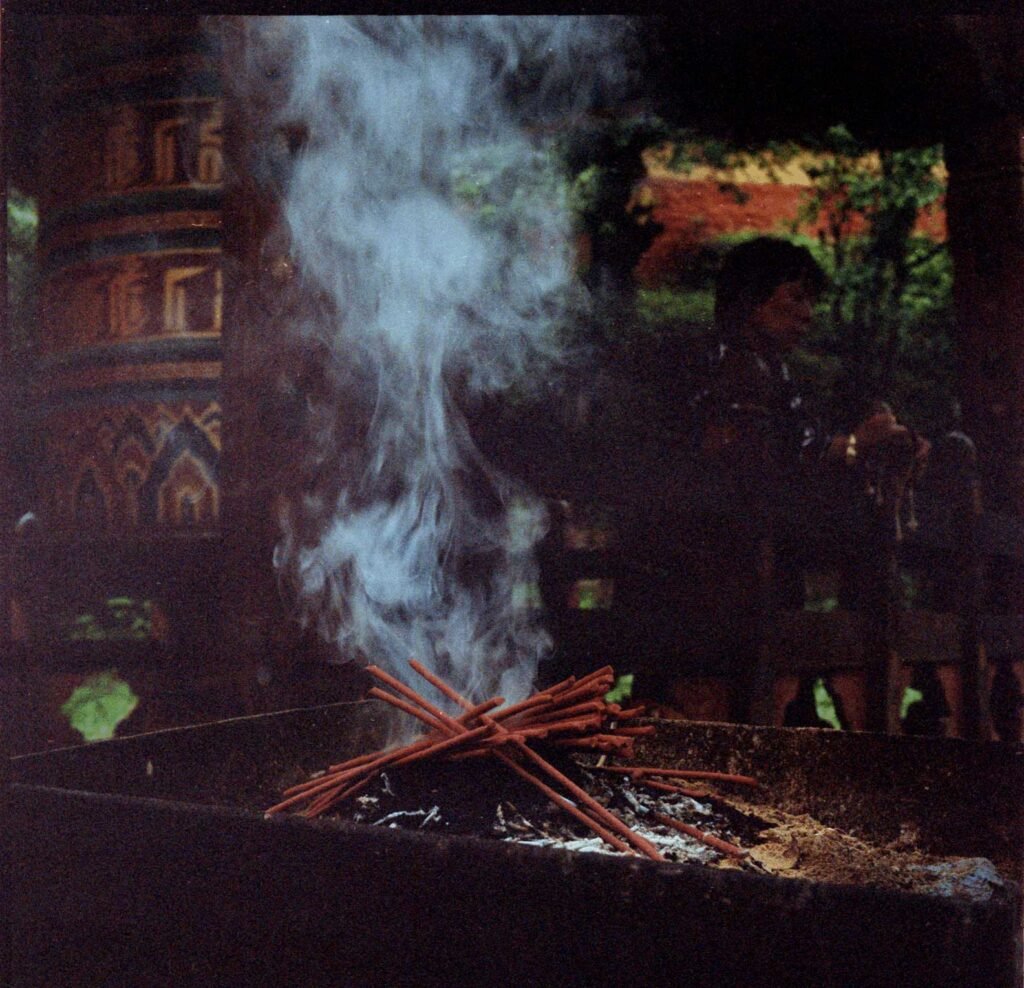
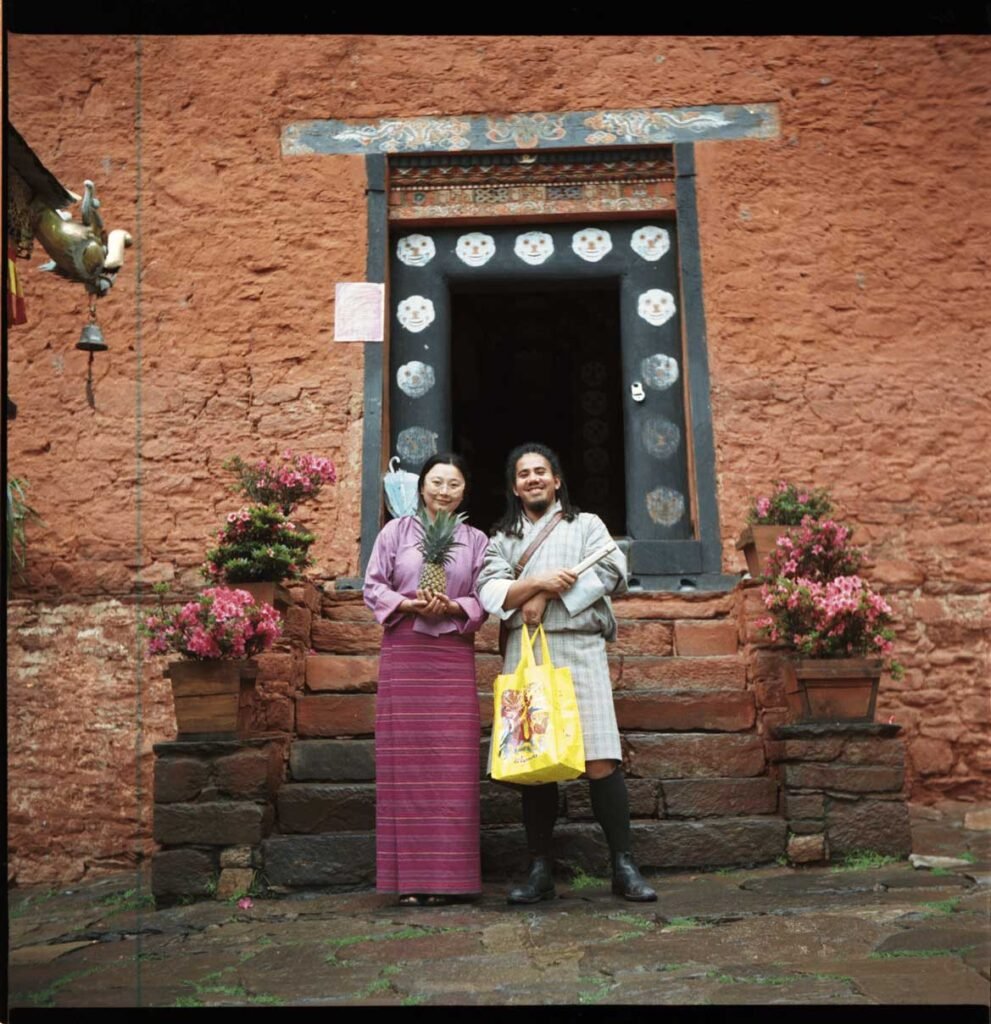
It was 8:30 a.m. and I was already almost late. I had bundles of incense, but I still needed to grab some fresh fruit from Kaja Throm market to complete the offering. Then I could pick up my friends and collaborators on this project, Yangday La and Wang Rana Gurung. As an American anthropologist doing research in Bhutan, I was excited to invite their creative and investigative energy to a new project sharing Bhutanese perspectives on everyday objects. Yangday had suggested we start off on the right foot—with a visit to Dechenphug Lhakhang to seek a blessing for the project.
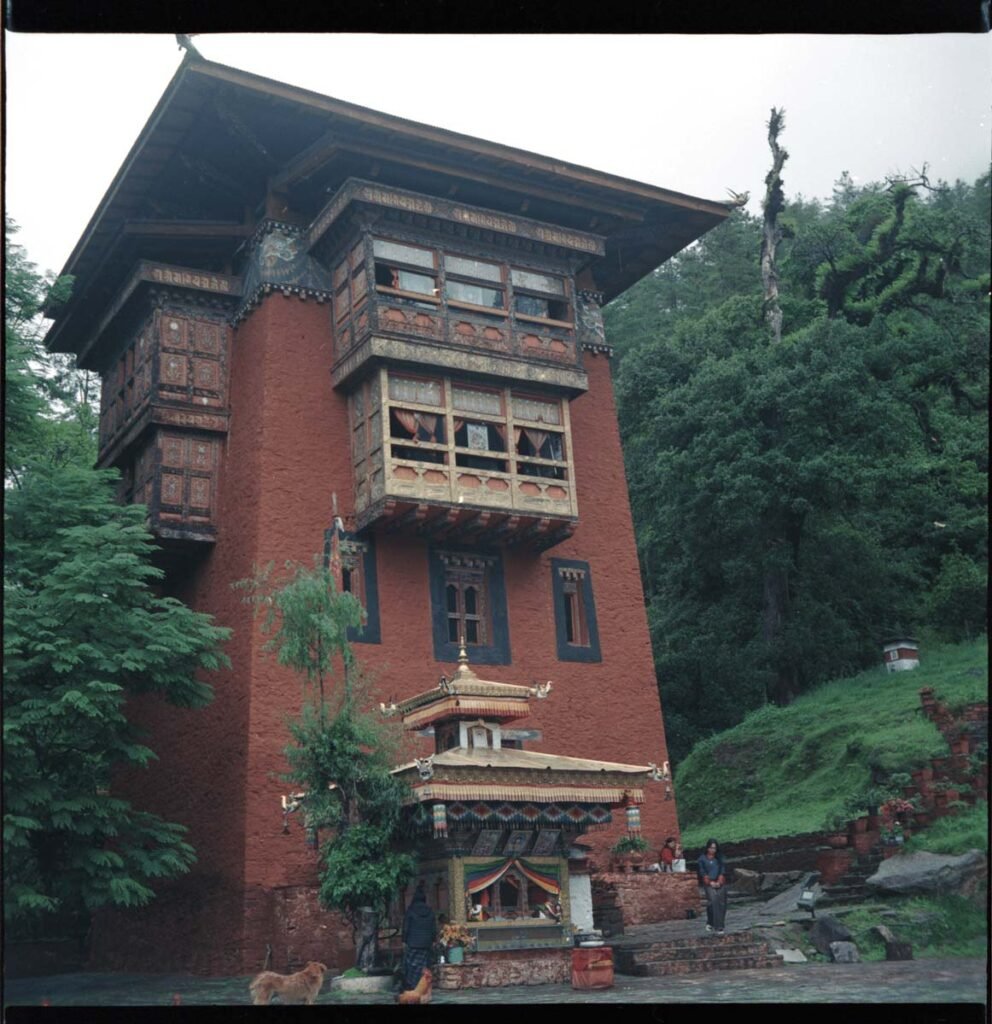
We drove up north in the Thimphu Valley, into the winding forest until the earth-colored goenkhang (sacred tower) residence of the fierce protector of Thimphu, Aap Gyenyen Jagpa Melen. From the car park we took a footpath up to the temple grounds, carrying our offerings. Roosters looked on from low branches, dogs perched on the roof, and a horse grazed in the morning dew. Dechenphug is a popular site to release animals from their fates as an offering or a karmic remedy. At the gate we offered one bundle of incense and each spun the large prayer wheel.
From there, Yangday and Wang continued without me. Dechenphug limits foreigners from entering the sacred temple.
Sitting before the temple with the morning stirring around me, I could feel the power of this place where the “hill sunk,” Thim-Phu, as the land itself was brought under Buddhist oaths. It felt right to pause and acknowledge the presences here before we began talking about the dynamic lives buzzing in Thimphu today.
Most temples across Bhutan welcome visitors regardless of origin or faith, however this space is reserved for Bhutanese. As a tempestuous and powerful protector deity, unfamiliar visitors risk upsetting Aap Gyenyen’s balance or causing disrespect.
Many Bhutanese bring their hopes and new beginnings to Aap Gyenyen at Dechenphug . It is an intimate interior where Bhutanese can cultivate their relationship to the protector and negotiate how they will shape their own futures. The restriction here is a protective one, respecting the protector and his potential, and allowing Bhutanese to engage with their relationship to place, the sacred, the past, and their own aspirations for the future.
This research starts with taking such restrictions seriously. How can we respect the boundaries of tradition and sensitivity even as we explore the new ways heritage lives locally in Thimphu. As we begin, we asked what can circulate and spark connections, and what deserves protection.
Inviting New Questions
The goal of this project is circulation. How can we respect boundaries, respect diversity, but find a common thread to pull together a sense of what connects people to Bhutanese identity? In the clear morning air, we drove down the road towards something new and something old.
How could we draw inspiration from respecting the ways that traditional knowledge circulates in Bhutan? To have a project that shared something more than just the secret or the sacred, but the everyday ways they become part of a larger sense of Bhutanese experience.
Drawing, the art of rendering objects in relation to each other, people, and their environment, provides personal perspective and experience, embodied knowledge, while also respecting boundaries of what people want to keep close. How could we use drawing as part of our research?
Bhutan has worked to preserve traditional arts and crafts, the Zorig Chusum with support in institutions, in incorporation to government projects, and in their persistence as a part of everyday life navigating the places and practices.
Yet, how younger generations find a sense of ownership over “tradition” is less often clear. This research focuses on professional producers, makers, and shakers in Thimphu to ask how they came to take up the objects we often take for granted.
Object Based Research, People-Oriented Perspectives
So, we want to empower people to see how tradition lives or finds a new place in their own lives, but how? We selected five sites and participants to capture a small sense of the diversity of Bhutanese identities and experience; interviewing all across the valley; in different disciplines and training; different genders; in multiple languages; and tried to convey the variety of paths they chose as they navigated between tradition and change, personal and community.
Objects such as cheese, incense, and home-goods like textiles not only provide sensory memories, they also travel—and can provide an unexpected link to home when far away. They transcend some of the diversity across Bhutan and lend an example of how to engage with those differences as meaningful and connected.
By beginning with objects, we open up a route to understand how people connect to each other through material: through shared memories, practices, and the chain of production that links communities together across the length of the country and beyond to make the product possible. Looking at the properties and qualities of objects also starts to show what makes these objects practical, or socially meaningful as we distinguish our own taste in goods. Object-based research can help start a conversation about how we produce value—both economically, and culturally.
Asking in a New Way
From the start, this project used collaborative research design—all co-researchers are stakeholders, and even participants can direct the focus of the conversation so that we can follow the connections we find rather than the ones we expect to see. The National Library and Archives of Bhutan is our gracious host institution, and we connect these makers’ experiences to their own documentation of these practices in the ICHlinks project—together these make two kinds of resources, lived experience and documented practice.
We recruited two up-and-coming creative voices in Thimphu, and from the beginning they were stakeholders and co-designers, using their own insight, experience, and skills to shape how the project could gather data, select participants, and connect to younger generations. They conducted visits to potential participants, we conducted five multi-lingual 1–2-hour site visits, and reviewed materials collaboratively to draw out themes. Each interview will result in a sketch and a short story that draws out the themes our participants shared were a meaningful aspect of their work and their own path to find it.
Thus, this project is not only a note passed across class to friends around Thimphu and beyond, it is a public humanities project not only designed for young Bhutanese, but with them and hoping to elevate their perspectives to the stage.
Goals
Our goals are humble, we hope you enjoy these stories, are enthralled by the images, and find support and connection to the lives and objects.
Dr. Tierney Brown did her initial fieldwork in 2022, when the air was thick with uncertainty of what would come after the pandemic lockdowns. She proposed the Drawn from Thimphu project as a way to spark more conversations about what is shared in practice, across generations, distance, and even lineages.
For the project, she collaborated with the National Library and Archives of Bhutan, her co-researchers Wang Rana Gurung and Yangday La, and had financial support from a Humanities New York Digital Humanities grant.
Images for this page were shot on Kodak Portra 800 with a Yashica LM twin lens reflex (TLR) camera.
Leave a Reply